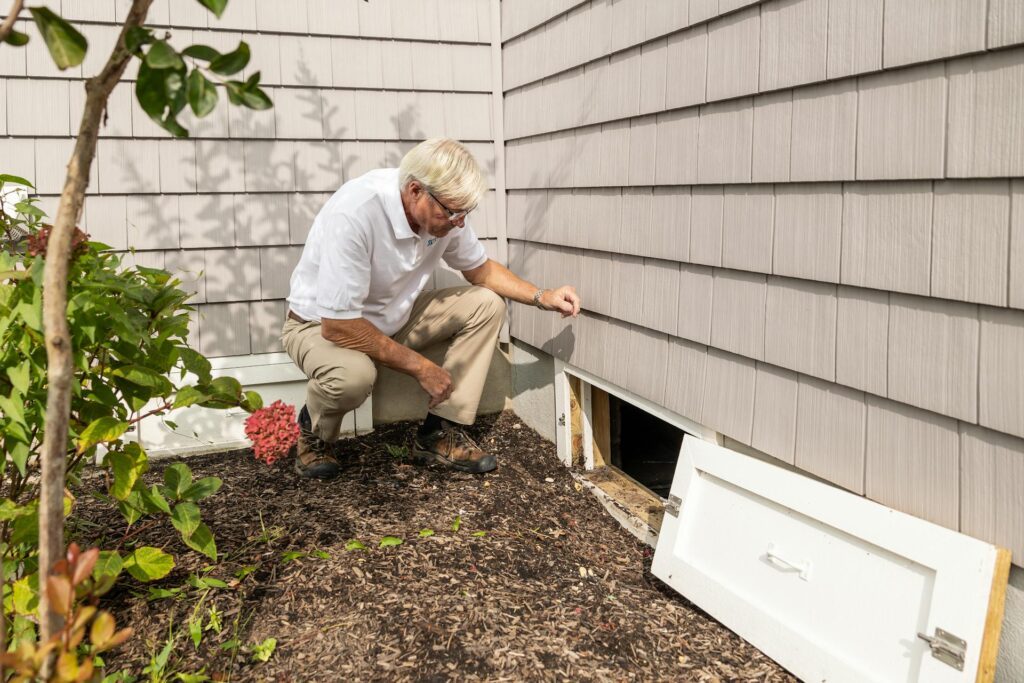
The Smyrna Vented Crawl Space
The dominant 1970s and 1980s housing stock in Smyrna – the ranch-style homes built west of Lee Victory Parkway, along Rock Springs Road, and across the older sections off Almaville Road – was built almost universally with CMU block stem walls, perimeter vents, and twenty-four to thirty-six inches of crawl space height. The construction reflects building-code conventional wisdom of the period that emphasized ventilation to manage crawl space moisture. Forty years of Tennessee summers have demonstrated the limits of that approach, and the long-term consequences are now widely visible across this housing stock.
Joist Sag and Sister Joist Repair
The signature problem in older Smyrna crawl spaces involves dimensional lumber joists that have absorbed cumulative moisture across decades and slowly lost stiffness. Floors above develop a noticeable spring or bounce, and over time develop measurable slope toward the center of long spans. Sister joist installation – bolting a new joist alongside the original to share the load – restores the framing capacity without removing the existing structure. Where the underlying piers or beams are still sound, sistering is the lowest-impact correction.
Vapor Barrier and Modern Encapsulation
The original construction of these homes typically did not include a vapor barrier on the crawl space floor, which means decades of soil moisture have evaporated directly into the framing above. Retrofit options range from a basic six-mil polyethylene barrier covering the dirt floor to full encapsulation with a sealed twenty-mil liner up the walls, sealed perimeter vents, and a dedicated dehumidifier. The right choice depends on existing moisture levels and the homeowner’s tolerance for periodic crawl space inspection.
Standing Water and Drainage Solutions
Where the crawl space floods during prolonged wet stretches, encapsulation alone does not solve the problem. The fix sequence runs from grading correction outside (extending downspouts, redirecting surface flow away from the foundation) to interior perimeter drain installation (a channel along the inside of the stem wall that captures wall seepage and floor water) to sump pump placement at the low corner. Only after standing water is fully managed does encapsulation become the right next step.
Smyrna Crawl Space Conditions Worth Investigating
- Bouncy or springy floor near the center of long joist spans
- Visible water or saturated soil on the crawl space floor
- Fungal growth on joists, beams, or subfloor
- Rust staining on fasteners, joist hangers, or pier hardware
- Musty odor in lower level rooms
- Insulation that has fallen or sagged from joist bays