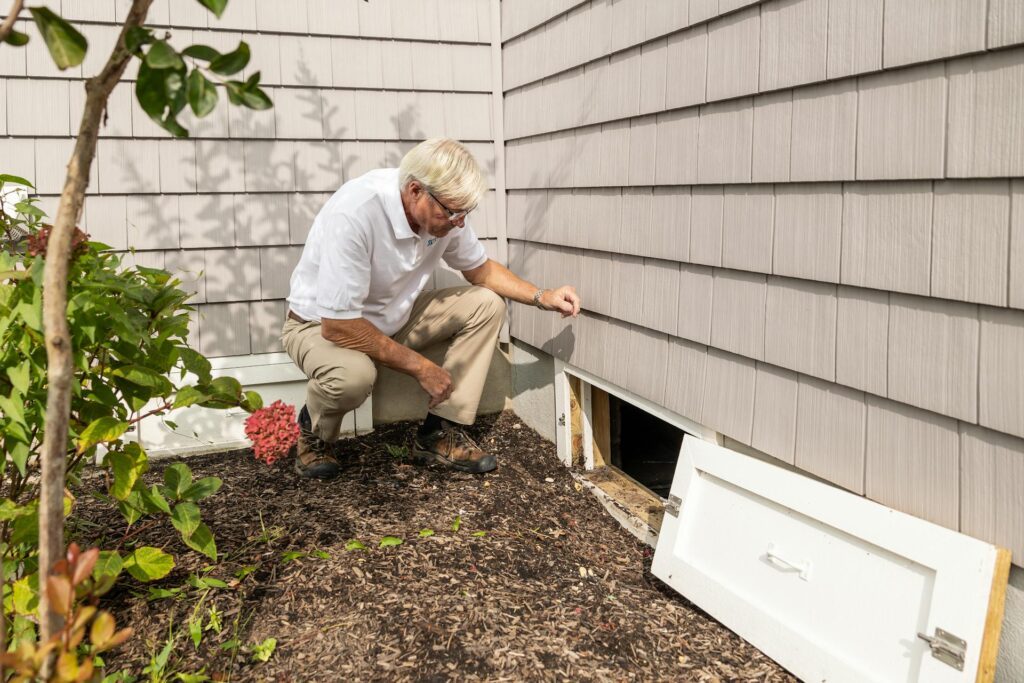
Pier-and-Beam Crawl Spaces in Rural Rockvale
The older Rockvale farmhouse stock – homes along Rockvale Road, Burnt Knob Road, and the side roads winding through the agricultural sections – rests on stone or early concrete pier-and-beam foundations with shallow crawl spaces below. The clearance under the floor framing is often as little as eighteen to twenty-four inches, which makes inspection difficult and creates the conditions where moisture problems progress unnoticed for years. Wood members in tight, poorly ventilated crawl spaces absorb cumulative moisture and develop the slow-progress problems that destroy pier-and-beam foundations.
Sill Plate Rot Above Stone Piers
The interface between a stone pier and the wooden sill plate above it is a moisture concentration zone. Capillary action draws ground moisture up through stone, condensation forms during temperature swings, and the wood rests on a continuously damp surface. Over decades, the sill rots from below while remaining structurally sound on top. The signature is a sill plate that crumbles when probed with a screwdriver while still appearing intact at first glance. Sill plate replacement involves jacking the structure, removing the rotted member, and installing a new sill with a proper moisture barrier between stone and wood.
Drainage to Daylight on Sloping Lots
Rockvale’s rolling rural topography offers an advantage that suburban subdivision lots rarely have: enough fall on the property to drain crawl space water to daylight without a sump pump. A perimeter interior drain channel inside the crawl space stem wall captures wall seepage and floor water, then a gravity-graded outlet pipe carries that water to a downhill discharge point on the property. The arrangement is more reliable than sump pump systems because it has no mechanical components to fail.
Vapor Barrier Strategy in Pre-War Construction
Pre-war Rockvale crawl spaces almost universally lack a vapor barrier, and decades of soil moisture have evaporated directly into the framing. Retrofit installation involves carefully spreading a heavy-mil polyethylene liner across the dirt floor, taping seams, and extending the liner up the inside of the stem wall by twelve to eighteen inches. The complication in low-clearance crawl spaces is access – the work has to happen on hands and knees, often crawling through tight spaces under existing ductwork and plumbing.
Conditions in Rockvale Farmhouse Crawl Spaces
- Rotted sill plates above stone or early concrete piers
- Visibly leaning piers that have settled into damp clay
- Mortar washing on stone pier joints
- Joist sag on long unsupported spans
- Damp soil floor without a vapor barrier
- Limited clearance making routine inspection difficult