Shallow Bedrock and Pinnacled Limestone
Rockvale lives up to its name. Limestone bedrock is unusually close to the surface across much of the community, and the bedrock relief is irregular – what excavators call pinnacled rock, where solid stone protrudes upward into what would otherwise be soil. For a slab pour, the consequence is uneven bearing: the slab rests partly on rigid stone and partly on compressible clay or weathered residuum. Differential bearing produces stress concentrations and the kind of mid-slab cracking that does not always trace to corner settlement.
Older Farmhouses on Stone Pier Foundations
Pre-war Rockvale farmhouses, common along Burnt Knob Road, Rockvale Road, and Lascassas Pike’s southern stretches, were built on stone or early concrete pier-and-beam foundations. The original construction relied on the abundance of local limestone for piers, and many of those piers remain serviceable a century later. Where they fail, the failure is usually localized: one pier sinks into damp clay, mortar washes out of a stone joint, or a sill plate rots above the pier from sustained crawl space moisture. The repair targets the failed pier, not the whole foundation.
New Construction on Cleared Pasture
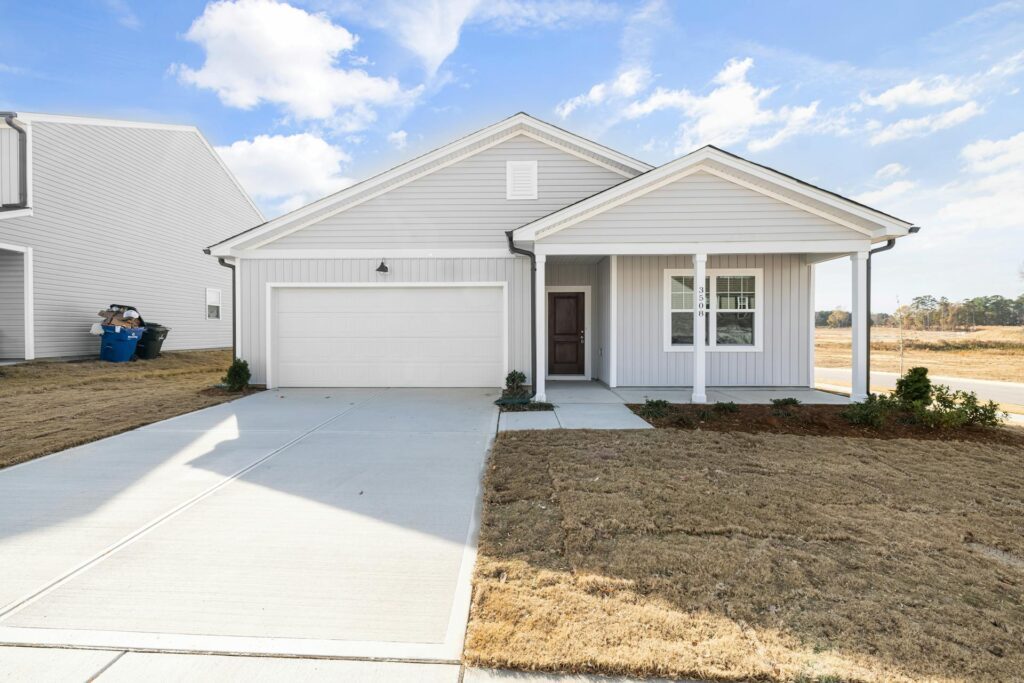
The newer Rockvale homes – built mostly after 2005 along smaller subdivision pockets and on sub-divided pasture parcels – are slab-on-grade with poured stem walls. Where pasture was cleared and graded with cut-and-fill, the same fill-side settlement pattern shows up that affects newer Murfreesboro subdivisions. The difference in Rockvale is the rock. Cut sides of pads frequently expose bedrock under the slab, while fill sides may have eight to ten feet of less-than-ideally-compacted material.
Drainage on Rolling Rural Lots
Larger Rockvale lots reduce the urban drainage problem of downspouts dumping water against the foundation, but they introduce a different one: surface water sheeting across pasture toward the house during heavy rain. Without an interceptor swale or proper grading, water collects against the uphill side of the foundation. Over years, that produces wet basement walls, hydrostatic pressure on stem walls, and eventually inward bowing on long unbraced runs.
Diagnostic Indicators in Rockvale
- Mid-slab cracking that does not radiate from a corner
- Tilted or sunken stone pier visible from the crawl space
- Wet basement wall on the uphill side of the house
- Sloping floors over a single span in an older farmhouse
- Cracks above garage door openings on newer construction
- Mortar joint deterioration on stone foundation walls