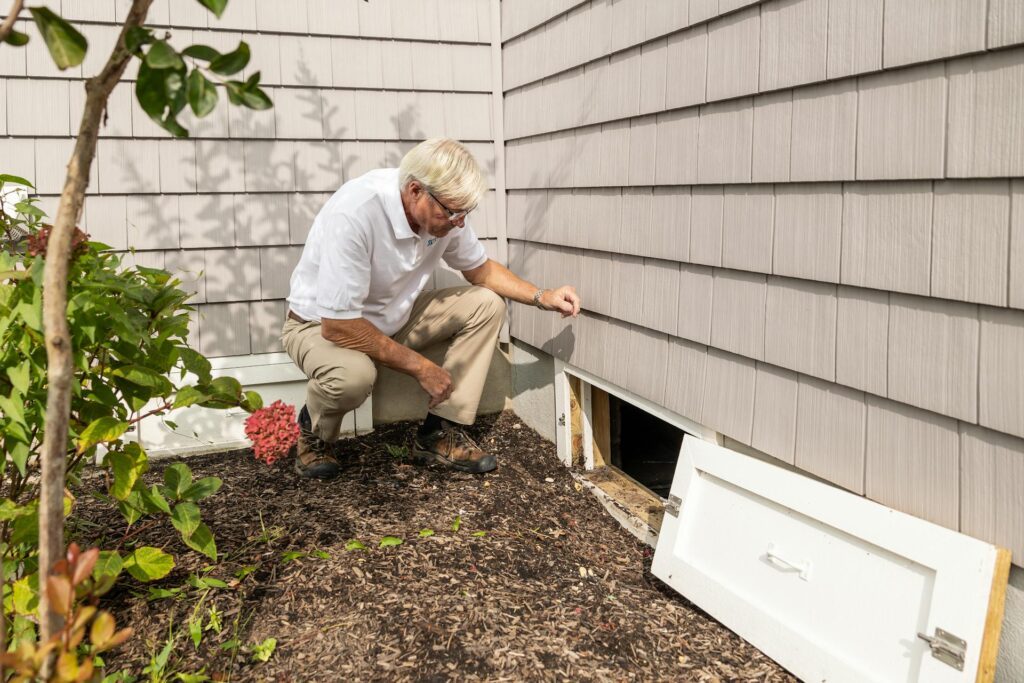
Encapsulation, vapor barriers, sub-floor leveling, and moisture control for the part of the house no one wants to crawl into.
Crawl Space Repair Overview
Crawl space repair covers anything from replacing rotted girders and shifting piers to encapsulation, vapor barriers, drainage, and sump pumps. The right scope depends on what’s actually happening underneath the floor — moisture, structural movement, pest damage, or all three.
Common crawl space situations in Middle TN
Tennessee humidity and seasonal storms make Murfreesboro crawl spaces a recurring source of problems. The patterns we see most often:
- Standing water after heavy rain because of poor exterior grading and vent placement
- Mold and mildew on subfloor framing from sustained 70%+ humidity in summer
- Sagging or bouncy floors above shifted piers or rotted girders
- Insulation that has fallen out of place — blocking vents and trapping moisture
- Vapor barriers that are torn, missing seams, or only cover part of the dirt floor
- HVAC ducts in the crawl that sweat in summer and lose cooling efficiency
- Termite damage on perimeter sills, especially in homes with vegetation against the foundation
- Cold floors in winter from underinsulated and unsealed crawl spaces
How crawl space repair is typically done
- Assessment. A crew member crawls (or sends a camera into) the space and documents what’s there: moisture levels, framing condition, pier alignment, vapor barrier state, drainage path.
- Diagnosis. Identify whether the issues are moisture-driven, structural, or both — and what’s feeding the moisture (drainage, plumbing, vent design).
- Plan. Written scope: what gets fixed, what gets replaced, what gets added (sump, dehumidifier, encapsulation), and the order of operations.
- Repair. Replace damaged framing, sister joists, install or shim piers, address drainage, install vapor barrier or full encapsulation, set up sump and dehumidifier if needed.
- Verification. Re-test moisture levels, walk the upstairs floors for bounce, and confirm sump and dehumidifier function.
What it usually costs in Murfreesboro
Vapor barrier replacement runs $1,500–$3,500 for an average home. Full encapsulation with dehumidifier and sump usually lands at $6,000–$12,000. Structural work — pier replacement, sister joists, girder repair — adds $1,500–$8,000 depending on scope. See our cost guide for the full breakdown.
Warning signs that need attention now vs. can wait
Call this week:
- Visible mold on subfloor or joists
- Floors that bounce or feel soft when you walk on them
- Standing water that doesn’t drain after rain
- Musty smell coming up through the floor or HVAC vents
- Visible termite tubes or wood damage on sills
- Sagging in the middle of the house above a known pier line
Monitor and address with normal scheduling:
- Damp dirt floor with no visible mold or framing damage
- An old vapor barrier that’s intact but dated
- Insulation that’s mostly in place but partly drooping
What we ask when you call
- What symptoms started this conversation — bounce, smell, mold, or moisture?
- How old is the home and has the crawl space ever been encapsulated?
- Do you have any standing water after rain?
- Do you have HVAC ductwork or equipment in the crawl?
- Can someone be home for a 30–45 minute inspection?
- Photos help — even a phone shot of the access door and one of the dirt floor.
Frequently asked questions
Is encapsulation worth it?
For most Murfreesboro homes with humidity issues, yes. Encapsulation usually pays back in HVAC efficiency and avoided mold/structural damage within 5–8 years. Homes with no moisture problem don’t always need it.
Will encapsulation eliminate moisture entirely?
Combined with a dehumidifier, yes — most encapsulated crawl spaces stay below 60% RH year-round. Without a dehumidifier, encapsulation alone can actually trap moisture if drainage isn’t fixed first.
Do you serve areas outside Murfreesboro?
Yes — Smyrna, La Vergne, Eagleville, Christiana, Rockvale, Walterhill, Blackman, and the rest of Rutherford County. See service areas.
How long does encapsulation take?
Most homes are completed in 2–5 days. Larger or more damaged crawl spaces can take a week or more.
Can I encapsulate myself?
You can install a basic vapor barrier yourself, and that’s better than nothing. Full encapsulation with sealed seams, sealed vents, and a dehumidifier is harder to get right DIY and most failures come from incomplete sealing.